

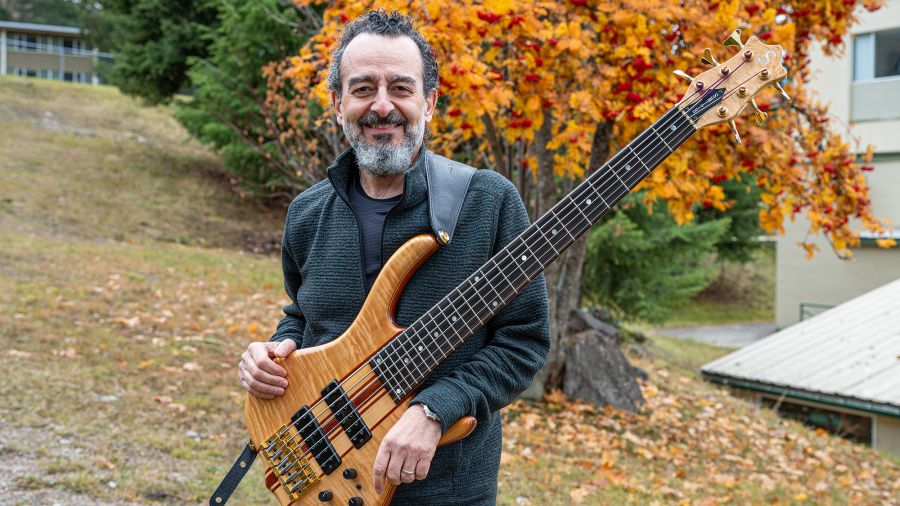
After 18 years working as a bassist and assistant music director with Cirque du Soleil in Las Vegas, Paul Shihadeh has brought his wealth of industry experience to Selkirk College's Contemporary Music and Technology Program.
Paul shares the journey that brought him to the college, how decades of performing, recording, touring and teaching influence his classroom approach, the lessons he's learned along the way and the advice that continues to guide him today.
Five Questions with Paul
*This interview has been edited for clarity and length.
What brought you here to Selkirk College?
I’ve been a professional bassist, music director and educator for 45 years. I was born and raised in Edmonton and was head of the bass department at what was then Grant MacEwan Community College. I moved to Los Angeles in 2001 and then to Las Vegas in 2004.
I was with Cirque du Soleil in Las Vegas as bassist and assistant music director for 18 years. My wife, Krista Monson, was with the company for 14 years as artistic director, casting director, show director and director of creation. Those are very intense jobs. I often did 10 performances a week, five days a week.
We were ready for a change of pace, but not sure of the next step. When the position of bass instructor at Selkirk College came open, I was intrigued. Selkirk College offers contemporary music, and there aren’t many programs like that in Canada. The program is also about music technology, and that’s a unique combination. Plus, my undergrad in music was at Berklee College of Music, and I appreciate that Selkirk College and Berklee College of Music have an academic partnership.
I remember the first time I drove into Nelson. It was at sunset, and the sight of the town against the mountains and water made me realize this place would be something special.
How does your experience shape your teaching and prepare students for music careers?
My career spans 20 years of freelance work, including worldwide touring, recording, and live performance, and 20 years of high-level, creative, and complex Cirque shows, which, for me, involved live performance, technology, and music direction. I try to impart all of those experiences to my students.
Different students have different needs, but the common thread is that they want to know how this business works.
I approach music education by exploring how creativity and craft can translate into a career. There’s a certain business aspect that is crucial for students to understand. The experiences I’ve garnered over the decades—playing every type of gig at least once—help me prepare them.
What opportunities do students have to perform, compose, record and collaborate while they're in the program?
Students take very hands-on and career-oriented courses, such as the Business of Music, alongside classes that explore how to collaborate, perform and put on the best show possible.
In Stage Performance Techniques, the class gives a full public performance. Students choose what to perform and lead ensembles as bandleaders.
Students also learn ear training, arranging, composition, film scoring, music history and much more!
You’re brand new here, but do you have a favourite Selkirk College moment yet?
I’ve been amazed at the instant sense of community. Our program dean, Tracy, actually drove around to check out some real estate for us before we arrived here. As soon as I arrived, Melody, the program chair, invited me out to dinner and then helped me retrieve some personal belongings from storage. I just kept thinking, “This is my chair, helping me move boxes out of my storage room!”
Another great moment has been discovering the level of talent in this faculty. This is a highly skilled, extremely talented and supportive group of colleagues.
The students are at a very high level. They are very open, and they want to learn. The college’s location is amazing, and the affiliation with Berklee is very valuable for students. I went to Berklee, and it’s an excellent opportunity for them to have this partnership.
What’s the best piece of advice you’ve ever received?
My father used to say, “Prepare to improvise.” Have everything ready and be ready to go in any direction. Whether you’re a performer or a teacher, that thought process can steer you for life.
I’ve always believed that it's best to guide your life in all aspects, not plan it. Guiding takes planning, and you’ll have to improvise along the way.