

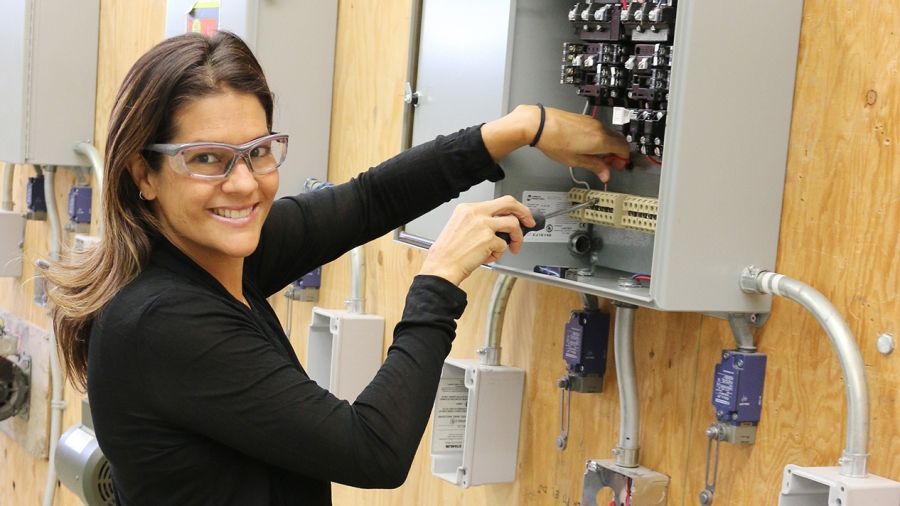
JC Hamilton is a Selkirk College graduate and current instructor. She guides students in building relevant skills that lead to rewarding careers in the trades.
Find out more about the benefits of working in the trades, how the industry is shifting and, of course, the many joys of living and working in the West Kootenay and Boundary regions!
*This interview has been edited for clarity and length.
What do you do here at Selkirk College?
I’m the lead instructor for the Plant Operator Program at Selkirk College’s Silver King Campus in Nelson, where I’ve been teaching for nearly eight years. It’s a dynamic and hands-on program that prepares students for careers in industrial operations, and I feel incredibly fortunate to be part of it.
Before stepping into this role, I taught in the Electrical Program. I was also involved in several foundational and exploratory trades programs, including Women in Trades, Pathways to Employment and Aboriginals in Trades. These programs are close to my heart. They open doors for students who might not have considered a career in the trades and help build confidence and skills in a supportive environment.
Being part of Selkirk College allows me to contribute to meaningful education while staying connected to the industry and the community I love.
How did your time as a student at Selkirk College launch your career?
My time at Selkirk College was a truly formative experience. I enrolled in the Electrical Foundations Program quite a few years ago, and it laid the groundwork for what became a rewarding career as an electrician here in Nelson.
One of the most impactful aspects of my time at Selkirk College was the mentorship I received from my instructor, Dan Obradovic. He not only supported me during my studies but also continued to check in on my progress after graduation. That ongoing connection eventually led to a new opportunity—Dan reached out when there was an opening for a relief instructor and encouraged me to apply.
What started as occasional relief work gradually evolved into more consistent teaching roles across various programs, ultimately leading me to where I am today. I absolutely love what I do.
Selkirk College was the perfect fit for me as a student. At the time, the electrical field had even fewer women than it does now, and I was the only female in a class of 18. It was intimidating at first, but the support I received from both my instructor and classmates made all the difference. The small class sizes and excellent instructor-to-student ratio allowed for personalized attention and hands-on learning, which helped me build confidence and develop strong foundational skills.
The trades programs at Selkirk College are well-equipped with great shops and knowledgeable instructors who genuinely care about their students' success. I’m grateful for the role Selkirk College played in launching my career—and now, in shaping the next generation of tradespeople.
What are the benefits of a career in the trades?
A career in the trades offers a wide range of benefits that go beyond just job security and good wages—though those are certainly important. One of the things I love most is how active and engaging the work is. You're constantly moving, problem-solving, and using your hands and mind in creative ways.
Trades careers also offer incredible flexibility. Whether you're interested in residential, commercial or industrial work, there are many paths to explore. The skills you develop can open doors to diverse opportunities—from starting your own business to becoming a designer or even transitioning into teaching, as I did.
Another major advantage is the ability to travel. Skilled tradespeople are in demand across the country and around the world, which means your career can take you places—literally.
Overall, the trades offer a fulfilling and dynamic career path with room to grow, evolve and make a real impact. It’s a field where you can build something tangible, contribute to your community and shape your own future.
How is the trades workforce shifting in terms of diversity? Why is this important?
It’s been incredibly encouraging to witness the growing diversity in trades education and industry hiring practices over the past several years. In my experience teaching Plant Operator classes, I’ve had cohorts where up to 50% of the students were women—a significant and positive shift from when I first entered the field. I’ve also seen increasing numbers of female students across various trades programs at Selkirk College, which is truly exciting.
A big part of this progress is thanks to the strong partnerships between Selkirk College and local high schools. Their outreach and support have helped ensure that trades are presented as viable and rewarding career paths to all students, regardless of gender or background, something that wasn’t the norm years ago.
What’s even more heartening is the genuine interest I’ve seen from industry partners in hiring individuals from diverse communities, including Indigenous Peoples, women and other underrepresented groups. This shift is more than just a hiring trend—it’s a meaningful change that brings fresh perspectives, new ideas and a richer dynamic to the jobsite. It’s a wonderful evolution, and I’m proud to be part of an industry that’s moving in this direction.
What do you love about living and working in the West Kootenay and Boundary regions?
What’s not to love about living and working in the West Kootenay and Boundary regions? It’s truly one of the most beautiful places in the province. We enjoy four distinct seasons, a stunning landscape of lakes and mountain ranges, and the kind of peacefulness that comes from being just far enough away from major city centres.
What makes this region even more special is the community. Many of us have chosen to move here from larger cities, drawn by the promise of a simpler lifestyle and a better work-life balance. Others are fortunate enough to have grown up here and continue to contribute to the vibrant, close-knit atmosphere that defines the area.
There’s a shared appreciation among residents for the natural beauty and the slower pace of life. It’s a place where people are intentional about where they live and how they live—and that creates a strong sense of connection and pride. I feel incredibly lucky to be part of this community.