

Geographic Information Systems - Advanced Diploma
Overview
GIS allows experts to map any type of spatial data so that it is interactive, complex and layered with valuable information. Be a specialist in demand in this field that touches a variety of industries from business to health care and environmental sciences. It can be used as a tool within almost every industry, including:
- Businesses like market-driven banking, ultimate client service and asset management
- Engineering like transportation planning, disaster management, use of historical data and terrain analysis
- Urban, rural and community planning
- Climate research, flood damage estimation
- Wildlife conservation, natural resource planning, water management
- Resource development and land management
- News and entertainment support, telecom and network services
- Government administration, taxation
- Health and medical research
- Law enforcement, accident analysis
Professional Training & Hands-on Experience
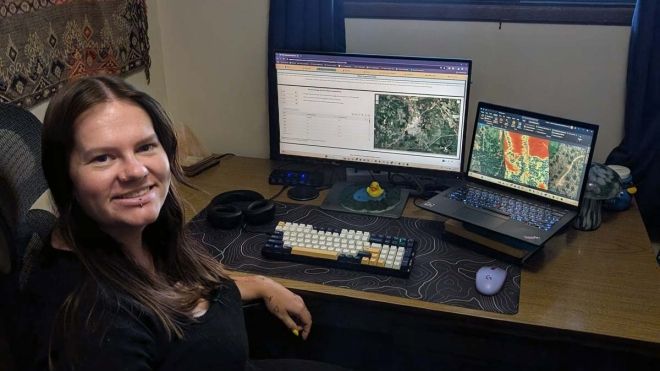
Within our state-of-the-art facilities, you'll get powerful, progressive hands-on experience and classroom instruction in subjects like:
- GIS applications and automation
- Remote sensing
- Internet mapping
- Database development and management
- Customized application programming
- Global positioning systems (GPS)
- 3D visualizations
- Data management techniques
- Open source, open data, and related software applications
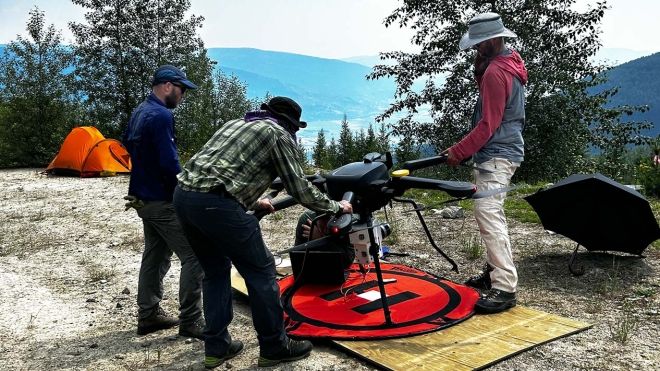
- Drone data collection and utilization

News
Program Outcomes
Upon successful completion of this program, learners will be able to:
- Engage and communicate effectively and ethically with diverse audiences in a professional context
- Apply critical thinking and diverse problem-solving approaches to address technical issues
- Organize project resources into a coherent framework that includes data, technologies, systems and participants
- Apply automation and data analysis processes, and leverage GIS and Remote Sensing capabilities to address diverse challenges and provide decision support, including real world scenarios related to sustainable development.
- Apply processes of spatial data creation and acquisition by utilizing a range of methods
- Create visually appealing, accurate, and intuitive representations of spatial data through maps, 3D models, apps and various types of portals to effectively communicate with specific audiences.
- Apply data management best practices relating to data standardization, database design, ethics, workflows, interoperability and sharing
- Utilize learning experiences that enhance self-sufficiency and future opportunities
- Recognize the diversity of Indigenous culture and traditions as distinct knowledge systems that are valid when building respectful engagement, consultation and collaborative relationships.
- Acknowledge the Calls to Truth and Reconciliation and the United Nations’ Declaration on the Rights of Indigenous Peoples as inclusive and informed constructs for Indigenous rights and title in the stewardship.
Admission Requirements
In addition to meeting the general admission requirements to Selkirk College, the applicant must meet the following program requirements to be considered fully-qualified:
Academic
- The minimum requirement for entry into the ADGIS is successful completion of 60 credits from a diploma/associate degree or applied/academic degree from an accredited post-secondary institution with an average GPA of at least 2.33.
- International students will be expected to provide documentation of English proficiency as per Policy 8611.
General
An applicant with a reasonable potential for success on the basis of work experience or equivalent education may be admitted, notwithstanding some deficiency in prior formal education. For this option, they should have demonstrated competency in the use of computer software and hardware technologies, including spreadsheets, word processing, and computer graphics. Applicants with no accredited post-secondary credential will usually require academic upgrading prior to starting the program. They are urged to apply for the program at least one year in advance.
Applicants with no accredited post-secondary credential may require academic upgrading prior to starting the program. They are urged to apply for the program at least one year in advance.
APPLICATION PROCESS
1. Before an applicant's file is considered to be complete, the following must have been received by the Admissions office:
a) completed application form;
b) official transcripts of all relevant post-secondary education; and
c) official transcripts of high school grades will be required for applicants entering without a credential from an accredited post-secondary institution
2. Deadline for completing the application file is normally one month prior to the commencement of the program.
3. Late applications will be accepted if space is available.
CO-OP EDUCATION
This program is eligible for co-op education opportunities. Co-op education courses will provide students with documented, program relevant work experience that is recognized with a designation on their transcript.
Please refer to Policy 8370 Selkirk College Co-operative Education and Selkirk College Co-operative Education Procedures for additional information regarding Co-op Education at Selkirk College.
In order to receive your credential in your program, you must maintain a minimum GPA of 2.00.
PROMOTION
1. Each semester must be completed with a Grade Point Average of 2.00 (60% average) or better with no more than two grades below a 60% to continue into the next semester. GPA will be based on all grades for courses scheduled for a given year and semester as per the course calendar. All grades below a 60% grade must be raised to a satisfactory level in order to graduate (see below).
2. Students not eligible to continue to the next semester will not be permitted to upgrade any marks but must repeat all courses with grades below a 60% prior to proceeding to the next semester.
3. Students receiving a final grade of 59% or lower in the prerequisite course will be required to withdraw from the subsequent course requiring the prerequisite. Students receiving the 59% or lower grade must re- register in, and successfully complete the course with a 60% grade or better before going on to the subsequent course.
GRADUATION
All courses must have at least a 60% grade, except for GIS 320 and Coop 301 which need a “CRG” to be eligible for graduation.
Courses
GIS302 - Introduction to Geographic Information Systems
GIS 302 Introduction to Geographic Information Systems is an introduction to GIS theory and application. Emphasis will be placed on understanding how geospatial features are represented and captured as data and how these data can be managed, analyzed and presented using state-of-the-art GIS tools. Hands-on expertise will be developed with ESRI's ArcGIS for Pro software. This material is continued in GIS 303. This course or equivalent credit is required to continue in the ADGIS program.
GIS303 - GIS Analysis and Automation
GIS 303 GIS Analysis and Automation will build upon the fundamentals of GIS theory by examining geodata models, data management and metadata, advanced analysis (raster and vector), 3D models, batching and scripting. The lab portion of this course will focus on the use of ArcGIS and its extensions for vector and raster analysis, Model Builder for analysis workflow control, and Python scripting for automation.
GIS306 - Introduction to Remote Sensing
GIS 306 Introduction to Remote Sensing will introduce the fundamentals of the basic physical principle of remote sensing and demonstrate the current applications of the technology. Students will become familiar with the basic image processing techniques for image pre-processing and data extraction. The course is designed to stimulate the current remote sensing activities in natural resource management.
GIS310 - GIS Data Management
GIS 310 GIS Data Management. Over the last few decades, geospatial technologies have evolved and infiltrated into an exponential number of organizations' and people's lives to the point where they are ubiquitous. Along with this great expansion of use comes an even greater need to access the right data and to manage and utilize it appropriately for each unique project. This course is an introduction to the fundamentals of dealing with spatial data and data management principles. We will explore key topics related to working with spatial data including data discovery, data dissemination and data use. Along with these topics comes the need to discuss ethics of data use and data use guidelines, data formats, standards and translation, metadata, as well as general data management and maintenance principles. The commercial software - FME will be introduced for data manipulation and translation from one format to the other.
GIS316 - Introduction to CAD for GIS Professionals
Introduction to Computer-Aided Drafting (CAD) for GIS Professionals explores the fundamental relationships between CAD and GIS systems, emphasizing their complementary roles in spatial data management. Students will learn to differentiate between CAD and GIS data models, file formats, and applications. The course focuses on practical workflows for converting and integrating data between CAD and GIS environments, maintaining spatial and attribute accuracy while adhering to industry standards. Through hands-on exercises and project work, students will develop critical skills in data conversion techniques, learn to effectively merge CAD and GIS data, and solve real-world spatial challenges.
GIS318 - Cartography and Geovisualization
GIS 318 Cartography and Geovisualization is the art and science of map making and map use. Preparation of high quality maps that readily reveal land management, planning, environmental or other concerns is critical to ensure that important messages are conveyed in an easily interpretable fashion. This course introduces the concepts and methods of cartographic communication, design, and geovisualization. Mapping fundamentals will address subjects such as coordinate systems, projections, datums, cartographic generalization, map types, and map design considerations. All cartographic principles and practices will be examined in relationship to GIS and other geospatial technologies. We will use ArcGIS software to complete most of the activities.
GIS329 - GIS Programming
GIS 329 GIS Programming equips students with essential Python programming skills for automating geospatial data manipulation, analysis, and map production using Esri's ArcPy and mapping modules. Students will learn to utilize Integrated Development Environment (IDE) effectively, develop geoprocessing tools, and solve real-world geospatial problems.
GIS390 - Applied Research Methods
GIS 390 Applied Research Methods involves the design and planning of a project idea from initial concept to anticipated final outputs. Topics include an overview of the steps necessary to successfully integrate GIS into the project decision-making process. Specific skills will be developed in project scoping and research proposal development, reference material management, and project presentation methods, including oral, poster, and written project documents. This course is a prerequisite for Co-op 301, GIS 491, and GIS 492.
GIS307 - Remote Sensing in Resource Management
GIS 307 Remote Sensing in Resource Management. Building upon the skills introduced in Introduction to Remote Sensing (GIS 306), this course will cover topics in the biophysical, geophysical, and human activity applications of remote sensing as well as change detection, object-oriented analysis, and active and passive imaging. Lectures will be integrated with labs emphasizing practical experience in remote sensing software applications using ENVI 5.x and QGIS 3.x. This course consists, in part, of an independent project designed and conducted by individual students to foster a scientific research approach in executing a remote sensing project. Each student will identify a project to be approved by the instructor during the first week of the class. Students are expected to work individually to complete their chosen project. The instructor will periodically discuss project progress and provisional results in the class.
GIS313 - Data Base Systems
GIS 313 Database Systems is an integral part of GIS, an associated relational database system is used for query and analysis operations that aid in solving spatial problems. This introduction to relational database systems includes topics of: database concepts, data definition, structured query language (SQL), and data integration.
GIS314 - Databases II
GIS 314 Database II. This course is a continuation of Database Systems I, and will cover relational database geodatabase skills using mainly Microsoft Access and ESRI Geodatabases with ArcSDE and a PostgreSQL backend. The purpose of this course is to introduce both conceptual and practical aspects of designing and developing both a database and a geodatabase. The course will provide an overview of some design methodologies and models. Following this overview, the course will cover database and geodatabase design and implementation using Access/Geodatabases and optionally ArcSDE on top of PostgreSQL.
GIS320 - GIS Professional Development
GIS 320 GIS Professional Development. Current and relevant professional development in GIS is essential for new graduates and experienced practitioners to achieve and maintain success in the continually changing GIS field. During this seminar course we will invite local GIS industry expert guest speakers to learn how their organization uses GIS technology and what skills are most required for success. We will also cover designation upon graduation, developing a professional development plan, and identify various GIS organizations.
GIS321 - New Media for GIS
GIS 321 New Media for GIS. In our continually evolving digital world, employers and clients often expect GIS graduates to have an online presence. We need a venue to showcase what we do and what we are capable of, and how we format and present our online portfolio can be make or break a new position or contract award. This New media course consists of a series of workshops designed to build digital presentation and presence skills using some popular New media tools, graphics editors, video editing software, websites and blogs plus additional freeware social media tools like Twitter and LinkedIn. At the end of this course students will have built their own websites hosting creative self-produced media and begun the process of building an online GIS network to begin or further their GIS careers.
GIS323 - Introduction to Global Navigation Satellite Systems and Unmanned Aerial Vehicles
GIS 323 Introduction to Global Navigation Satellite Systems and Unmanned Aerial Vehicles will first introduce the fundamental concepts of Global Navigation Satellite Systems with specific emphasis on Global Positioning System (GPS) and the applied technologies for GPS data collection and GIS integration. Through interactive instruction and hands-on course exercises, students will work with a variety of GPS tools and field collection techniques to learn how to create, edit, update and manage geographic information. Emphasis areas will include familiarity with GPS receivers, GPS processing software, data collection standards and cartography. The second part of the course will introduce Unmanned Aerial Vehicles (UAV) technology. More specifically, this includes introduction to photogrammetry, characteristics of images obtained from UAV, mission planning, acquiring images using UAV and digital image processing. Students will work on series of assignments to get the hands on experience on data acquisition and image processing.
GIS325 - Internet Mapping
GIS 325 Internet Mapping investigates the full range of Internet and intranet mapping, including static maps, online data, and web map (image) and feature services. Most of the emphasis of the course will be on the use of ESRI's ArcGIS Server software to serve maps over the Internet. Free mass media applications Google Earth and Google Map applications will be introduced. Web map OpenGIS Consortium standards and freeware server and viewer software will be discussed. The course curriculum will be delivered using lectures and hands-on class exercises. Students will author, administer, design and manage interactive Web Mapping projects through a number of lab assignments, and through a term project. The term project will be the development of a site which will be served through the campus intranet and/or through the SGRC public server. The course requires prior knowledge of GIS theory, BC datasets, and ArcGIS software which students have previously acquired in ADGIS courses GIS 302, 303, 310 and 318.
GIS331 - Advanced Topics In GIS
In GIS 331 Advanced GIS Application we will learn about and practice applying GIS to spatial problems; arguably one of the most challenging parts of putting this powerful technology into action. We will focus on GIS for Health Analysis as well as other applications of GIS (such as crime analysis) by utilizing sophisticated analysis techniques including hotspot analysis, Getis-Ord G* statistic, exploratory regression, Ordinary Least Squares (OLS) and Geographically weighted regression (GWR).
GIS491 - Technical Project
GIS 491 Technical Project builds on the specific skills developed in GIS 390 and involves building a project database, conducting analyses with a variety of geoprocessing tools, and producing final products. This course provides an opportunity for students to integrate their knowledge of CAD, GIS, remote sensing and databases to solve a specific problem. Students will combine practical application with project management skills to complete their project with the guidance of a supervisor.
COOP301 - GIS Co-op Work-term I
COOP 301 is a (paid) work-term which fosters partnerships between students, employers and institution; to bring classroom learning into the workplace. Co-op Education is a process of education that formally integrates students’ academic study with periods of related work experience. By connecting with employers, students will gain valuable hands-on experience in the field of Geographic Information Systems (GIS).
Tuition & Fees
All amounts are estimates and are subject to change. Tuition amounts are based on a full-time course load. Please note that many programs have additional costs beyond those listed here. For more information, please visit Tuition & Fees.
Find Out More
We look forward to connecting with you! Fill out this form and we'll reach out to you.