

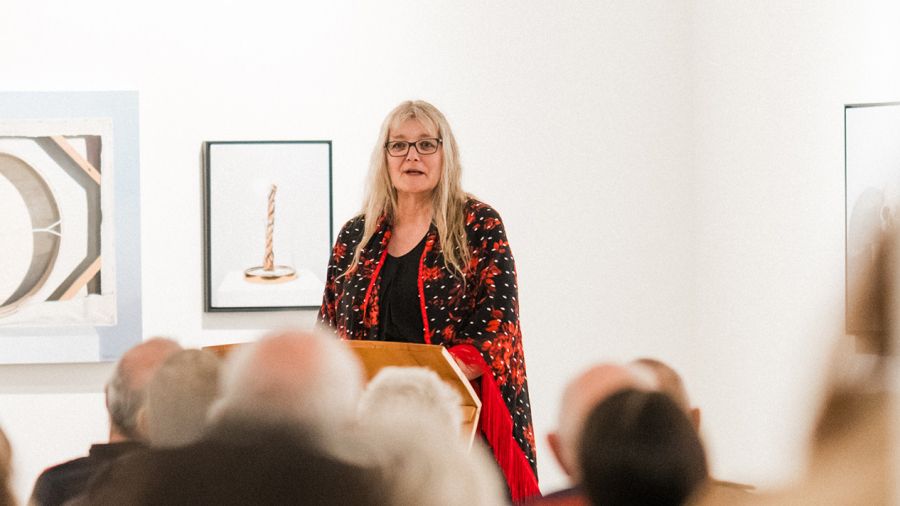
Michele Morin is a Métis woman, daughter, mother, sister, auntie, cousin, friend and scholar. A proud member of her Métis community and a traditional Knowledge Keeper, she practices Two-World Walking and Two-Eyed Seeing—working diligently to balance a contemporary Métis lifestyle with Eurocentric academia.
Michele is a Selkirk College graduate and current instructor of Indigenous Studies as well as an Indigenous Social Work instructor for the University of Victoria School of Social Work.
Michele’s research covers many topics, but they all involve sharing multiple knowledges, multiple epistemologies, axiologies and ontologies so that we can honour and work toward decolonization through educational change.
Learning with the Land
Michele shares how honouring and learning with the land are central to her worldview and her teaching practice.
*This interview has been edited for clarity and length.
What do you do here at Selkirk College?
Selkirk College calls me an instructor of Indigenous studies. I see myself as more of a knowledge-sharing facilitator. I believe that life is a learning journey, and I learn from and with students every time we interact. I learn as much, if not more, from them than I will ever offer in return.
How do you intentionally integrate learning with the land into your teaching practice?
I see The Land (it’s a proper name, so I have capitalized it) as a living being—as a distinct entity. The Land offers us a space to exist and provides us with all that we need. Without it, we would not be here. I honour The Land in all that I do.
Reciprocity is a large part of my Indigenous worldview, and that naturally shows in my knowledge sharing. Descartes said, “I think, therefore I am,” for me, “The Land is, therefore I am.” I cannot offer any knowledge without honouring, acknowledging and spending time with The Land.
Can you share an example of a lesson or activity where learning with the land played a central role?
The Land plays a huge role in every course, lesson and activity that students and I share.
Recently, in INDG 302: Indigenous Health and Healing, we spent a class discussing traditional medicines. Most students were stressed or anxious about mid-term exams in other classes. We went out onto The Land for a walk. We talked about plants and animals, local histories, paused to admire the eagle’s nest at the oxbow, and acknowledged the many gifts that The Land offers us, and everyone became more grounded and relaxed. Afterward, we discussed our connection to The Land, acknowledged The Land and its many gifts to us, and how that contributes to our health.
How do the history and culture of the West Kootenay and Boundary Regions impact what you teach?
Place-based connection and community are a huge part of what I offer to students. We live in a very beautiful area, and Selkirk College’s Castlegar Campus is in a unique place—we are at the confluence of the Kootenay and Columbia Rivers, a perfect way to illustrate local Indigenous and Eurocentric histories and cultures, and how they have, and continue to, intersect. This place has a living connection to the Indigenous Nations that have traded here, caretaken here and called this place home for millennia.
Offering connections to local history and culture, with Selkirk College’s Nation partners, and how local histories and cultures influence our contemporary lives is an important piece of knowledge sharing.
How do Indigenous ways of knowing, being and doing guide your teaching?
As an Indigenous person with a contemporary Indigenous worldview, Indigenous epistemology (ways of knowing), ontology (ways of being) and axiology (ways of doing) guide everything I do, including teaching.
Respect, reciprocity, relationship, relevance and responsibility are some of the guiding principles of everything that I do, and this translates into the classroom—it's who I am and how I walk in this world.
What makes teaching and learning at Selkirk College unique?
Teaching and learning at Selkirk College is truly a blessing. I started my learning journey as a student at Selkirk College, and now I am blessed to be an instructor here.
The smaller class sizes and intact natural beauty allow for a sense of community and allow time to cultivate healthy, respectful relationships with students, co-workers, and The Land and all of her inhabitants, while sharing relevant knowledges and honouring our responsibilities to walk in a good way.
Explore courses with Indigenous content.
Photo credit: Louis Bockner