

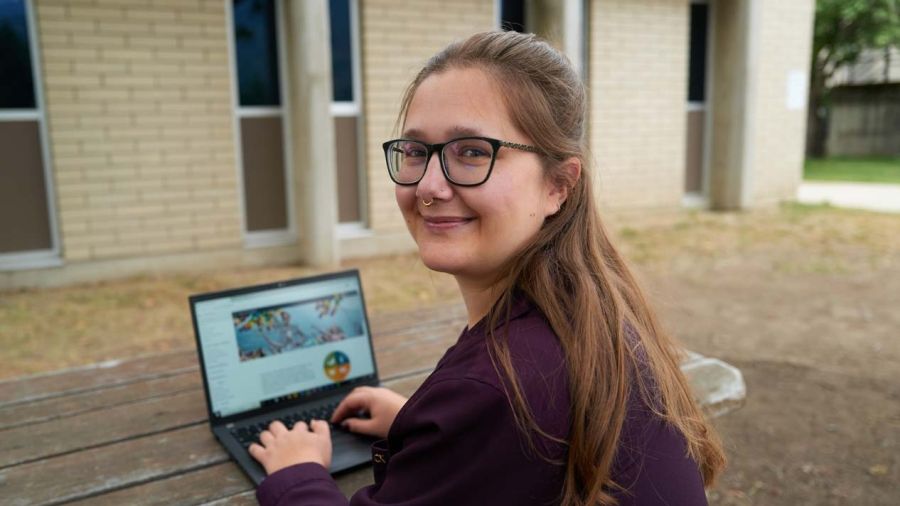
Leeza Perehudoff, Selkirk College graduate and employee, truly represents what the college is all about! Her work as a research assistant with Selkirk Innovates is deeply connected to local land and communities. In fact, she helps monitor and report on environmental, economic, cultural and social well-being across the region through the State of the Basin project.
Recently, the Columbia Basin Trust and JCI Kootenay recognized Leeza as one of the Columbia Basin’s 30 Under 30 for her contributions to rural, community-based social science research and her passion for community, local cultural heritage, sustainability and lifelong learning.
We chatted with Leeza to learn how her connection to place inspires her work at the college.
*This interview has been edited for clarity and length.
What do you do here at Selkirk College?
I support social science research with the Social Innovation Lab. Depending on the project, my work may involve conducting literature reviews; collecting and cleaning secondary data; analyzing quantitative, qualitative and spatial data; writing research briefs, newsletters and reports; and delivering presentations.
I sum this up as rural research for evidence-based decision-making and action!
How did your time as a student at Selkirk College prepare you for your career?
My education at Selkirk College gave me such a strong foundation for my career.
I gained skills in technical writing, statistics and quantitative data analysis from the Recreation, Fish and Wildlife Program.
Then, I built expertise in spatial data analysis, programming, internet mapping and cartography through the bachelor’s degree in Geographic Information Systems.
I was able to test out different paths and discover the kind of work I feel most passionate about through Co-op Education. Together, these experiences prepared me to succeed in my career.
The West Kootenay and Boundary regions are so unique. How do the local and land communities impact your work?
Connection to place is vital to my work.
I was born and raised in Castlegar. Through my experiences with Environment and Geomatics, I gained an understanding of the native plants, wildlife and fish of this place, as well as the stewardship of these lands by First Nations since time immemorial.
I also draw on my knowledge of local geography, along with how community demographics and economic activities have shifted over time and continue to change. The West Kootenay and Boundary regions include 17 municipalities and 16 regional district electoral areas, each with distinct challenges and opportunities.
Being grounded in place is important for recognizing the uniqueness and complexity of each community.
There is so much cutting-edge work being done here. Can you tell us about a project that surprised you?
It’s difficult to pick just one project! Every research area at Selkirk Innovates is doing remarkable work. These are just a few examples, not nearly encompassing all we do.
In the Social Innovation Lab, Jayme Jones is leading research on rural homelessness in partnership with local governments and numerous community organizations. Dr. Sarah-Patricia Breen is investigating critical rural issues, including food systems, transit and workforce development. Lauren Rethoret is supporting local residents and communities to take climate action. Dr. Tracey Harvey is advancing research on the regional cannabis sector. And Dr. Jennie Barron is supporting classrooms, campuses and communities to enhance dialogue across differences.
The Advanced Computing team, led by Jonathan Doyle, is downscaling climate and weather models to small communities, improving local analyses and projections.
The GIS & Natural Resource Management team is identifying tree species and monitoring forest health using LiDAR, and mapping fish refugia with thermal imaging.
It’s hard to keep up with what the Advanced Manufacturing team is doing, because they’re so cutting-edge. One of their projects that surprised me is a partnership with Tempus 3D, which sees plastics recycled into filament for 3D printing and then used to produce medical-grade prosthetics.
And the Ion-source team was just recently established, so I can’t wait to see how their research progresses.
I am so grateful and proud to be a part of Selkirk Innovates.